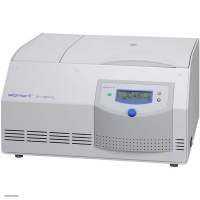
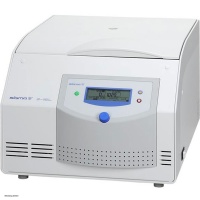
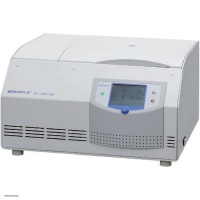
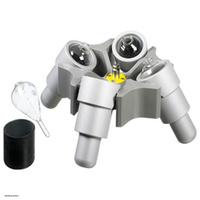
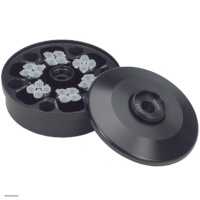
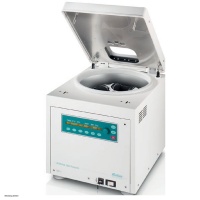
Swing-out rotor 24 x 1.5/2.0 ml for Sigma 3-16L, -KL, 3-18KS
This rotor has been specially developed to efficiently cover a wide range of protocols in molecular biology, biochemistry and clinical diagnostics. It offers a robust design and enables high capacity with outstanding centrifugation results. Thanks to its sophisticated design and innovative manufacturing technologies, it is particularly durable and therefore a preferred choice over other rotor systems on the market.
Maximum performance and flexible application options
Professional laboratories benefit from this rotor's high compatibility with Sigma centrifuges, in particular the 3-16L, 3-16KL, 3-18KS and 3-18KHS models. Its swing-out function ensures that samples are handled gently and separation is uniform. Compared to static rotors, this free-running type offers the advantage that the sample tubes are positioned almost horizontally during acceleration and braking. This enables optimum separation and prevents uneven stratification or contamination. Whether for processing protein samples, performing DNA/RNA extractions or blood analyses, it impresses with its versatile application options without compromising on performance or safety. Technical highlights at a glance Maximum speed (3-16L): 12,500 rpm (max. RZB 12,927 × g)
- Maximum speed (3-16KL, 3-18KS, 3-18KHS): 14,000 rpm (max. RZB 16,215 × g)
- Capacity: 24 × 1.5/2.0 ml reaction vessels
- Adapter: Suitable for 0.25/0.4 ml, 0.5/0.75 ml and 0.2 ml PCR vessels
- Aluminium hermetic lid: Guarantees safe and contamination-free sample processing
- Autoclavable: Enables easy sterilisation
- Robust design and long service life
In addition, the load can be distributed evenly across all positions, ensuring that the samples always deliver reproducible results. The option of using different tube sizes with suitable adapters allows flexible handling for various applications in research and routine work. High safety standards and certifications The rotor is manufactured in compliance with strict quality and safety standards. This includes CE markings and ISO certifications to guarantee reliable performance even in demanding environments such as high-security laboratories or clinical facilities. The design with a hermetic lid helps to ensure that laboratory staff are protected as well as possible and contamination is effectively minimised.
- DNA/RNA extractions from blood, tissue or cell cultures: Thanks to suitable adapters, small PCR vessels can be used safely, enabling high yield and purity of the isolated nucleic acids.
- Protein analyses and enzyme tests: The efficient separation of highly sensitive samples in reaction vessels promotes safe and meaningful results.
- Clinical diagnostics: Blood and urine analyses benefit from uniform sedimentation, which facilitates the evaluation of metabolic parameters.
- Biochemical procedures: Whether pH screening or detection of plasmid DNA - uniform separation in a wide variety of sample formats makes the process straightforward and scalable.
Frequently asked questions (FAQs)
What is the maximum number of reaction vessels that can be used?
Up to 24 reaction vessels (1.5/2.0 ml) can be placed in the rotor. Adapters for smaller vessel sizes are also available.
What is the maximum speed that can be achieved?
This varies depending on the model: for the Sigma 3-16L, the maximum is 12,500 rpm, and for the 3-16KL, 3-18KS and 3-18KHS models, up to 14,000 rpm.
Is the rotor really suitable for sensitive samples?
Yes. Thanks to its coasting function and uniform acceleration and braking, the rotor helps to gently separate sensitive samples without compromising their quality or structure.
Which standards and certifications are relevant?
The rotor complies with all relevant standards such as CE and is manufactured according to ISO standards to ensure maximum safety and performance.
Can different vessel sizes be processed simultaneously?
In general, it is recommended to use compatible adapters to ensure optimal positioning for each vessel format. Special adapters are available for common sizes such as 0.25/0.4 ml, 0.5/0.75 ml and 0.2 ml PCR vessels.
Conclusion
The swing-out rotor impresses with its reliable performance and wide adaptability to different vessel sizes. Whether for demanding molecular biology, biochemistry or clinical applications, it enables fast and convenient sample separation. Thanks to its high-quality construction and compliance with international standards, it is ideally suited for laboratories that value efficiency, safety and reproducible results. With its high speed, robust design and flexible adapter options, this rotor offers a durable and cost-effective solution for complex centrifugation tasks.