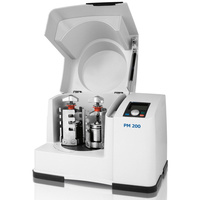
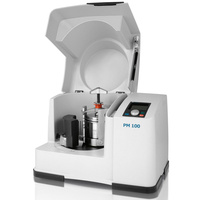
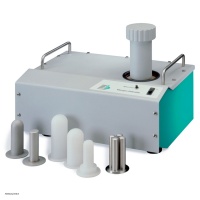
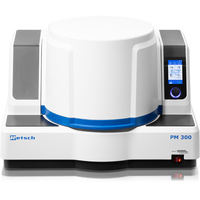
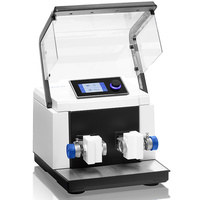
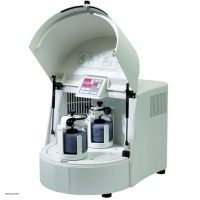
Retsch Planetary Ball Mill PM 400
The Retsch Planetary Ball Mill PM 400 is a powerful laboratory and industrial mill designed for the demanding fine grinding, mixing and homogenisation of a wide variety of materials. This model is particularly recommended for applications in materials science, chemistry, geology, metallurgy, environmental technology, and the pharmaceutical and food industries, where high flexibility, precision and safety are required. Compared to similar models on the market, the device impresses above all with its powerful quadruple grinding system, outstanding final fineness down to the submicrometre range and extensive safety features that have been developed to meet the requirements of modern laboratory operations.
Performance features for professional users
With versatile functionality and a robust, industrial-grade design, the planetary ball mill meets the highest demands for efficiency, process reliability and ease of use. The most important technical features at a glance:
- Mill type: Planetary ball mill with 2 or 4 grinding stations
- Maximum feed size: < 10 mm
- Final fineness: < 1 µm, for colloid grinding up to < 0.1 µm
- Sample volume: Maximum 4 x 220 ml or 8 x 20 ml (with stacked beakers)
- Sun wheel speed adjustable: 30 - 400 min-¹
- Operation: Digital setting for grinding time, interval and pause time (between 00:00:01 and 99:59:59)
- Safety: Comfort grinding beaker type, safety lock, optional gas cover
In addition, the model supports numerous other features that offer high added value for professional operation:
The Retsch PM 400 uses an impact and friction principle for fine grinding of a wide variety of material types - from fibrous plastics to hard minerals and metallic alloys. The effective sun wheel diameter of 300 mm in combination with an acceleration of 26.8 g ensures efficient energy utilisation and short processing times. The selection of materials for grinding tools (e.g. hardened steel, tungsten carbide, agate, sintered corundum, zirconium oxide) allows precise adaptation to different applications and prevents cross-contamination during metabolism. Various grinding beaker sizes from 12 ml to 500 ml support flexible sample size selection, allowing both small research samples and larger homogenisation batches to be processed. The control and reproducibility of the processes is ensured by the storage of up to ten standard operating procedures (SOPs). The mill has RS 232 and RS 485 interfaces for seamless documentation and integration into laboratory information systems. A 3-phase asynchronous motor with frequency converter provides high drive power (1.5 kW) with efficient energy consumption (approx. 2100 VA). The modular design and safety features, including the patented Counterweight, FFCS and SafetySlider technologies, ensure operator protection and maximum operational safety. Certifications and standards The device complies with the current CE certification and is also equipped with the following patents/utility models:
- Counterweight (DE 20307741)
- FFCS - Friction Force Compensation System (DE 20310654)
- SafetySlider (DE 202008008473)
These patents and standards document the quality and innovative strength of the product, as well as its compliance with European safety guidelines for laboratory equipment.
Specific application examples
The planetary ball mill has a wide range of applications in laboratory practice. Here are some typical applications:
- High-precision comminution and grinding of rock, slag, building material samples and ceramics (e.g. for geological or environmental analysis)
- Homogenisation and fine mixing of pharmaceutical powders, additives and heterogeneous chemical batches
- Wet and dry grinding of biological materials such as grain, plant samples or polymeric materials for sample preparation for further analysis
- Mechanical alloying for metallurgy, e.g. production of complex alloys by mixed grinding of metal powders
- Colloidal grinding for chemical and biotechnological research, e.g. for emulsions, suspensions or the production of nanoparticles
The container material and size as well as the grinding parameters can be ideally adapted to the specific substance and objective, such as grinding cement clinker, quartz, stainless steels, plastics or biological matrix materials.
FAQ - Frequently asked questions about the application
How flexible is the parameter control during the grinding process?
Parameters such as grinding time, interval and pause time can be set digitally and easily adapted to the respective sample material. Up to ten different SOPs can be stored.
What safety features protect the operating personnel?
The mill has a patented safety lock, an optional gas cover and the SafetySlider mechanism, which guarantees safe handling of the grinding beakers.
Is process monitoring possible?
Yes, measuring the energy input allows continuous monitoring of the grinding processes. In addition, RS 232/RS 485 interfaces support documentation and integration into LIMS.
Which materials are suitable for grinding tools and jars?
Depending on the sample material, grinding tools made of hardened steel, stainless steel, tungsten carbide, agate, sintered corundum and zirconium oxide are available to minimise carryover and abrasion.
Conclusion
The PM 400 planetary ball mill offers a compelling combination of precise fine grinding, high operational and process reliability, and maximum flexibility for a wide range of applications in research, development and routine analysis. Its advanced technical features, patented safety mechanisms and compatibility with industrial and scientific standards make it the first choice for laboratories that place the highest demands on reproducibility and safety in sample preparation.

 Details
 Details
 Details
 Details
 Details
 Details
 Details
 Details
 Details
 Details
 Details
 Details
 Details
 Details
 Details
 Details
 Details