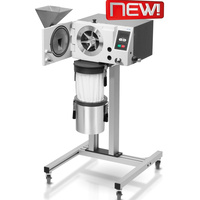
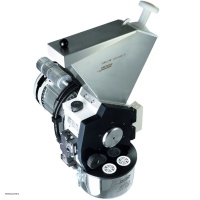
Retsch Rotor Beater Mill SR 300 - ProfiLab24 GmbH
99
100
24
4
stars -
Professional service
Customer
Young team with a lot of ambition and quick answers to all questions. We needed a complete laboratory equipment for our new location. The team of Profiab24 has arranged everything.
Retsch Rotor Beater Mill SR 300
Item number: RET_12008
EAN: 4064343320207
Manufacturer:
Retsch
Now only
13.129,00 €
Manufacturer’s suggested retail price:
13.820,00 €
Excluding 19% VAT. ,
plus
(Sperrgut)
(including 19% VAT. 15.623,51 €)
Retsch Rotor Beater Mill SR 300. Order at ProfiLab24 Online catalog for laboratory equipment. Top service. Secure payment.
Retsch Rotor Beater Mill SR 300, 3/N~ 400 V, 50 Hz
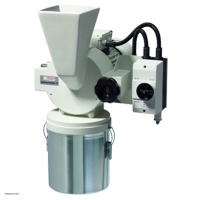
The Rotor Beater Mill SR 300 is suitable for coarse and fine size reduction, either in batches or continuously. It can process dry, soft, medium-hard, organic and inorganic substances. Its high speed in comparison to the SR 200 allows a significantly higher throughput and fineness. The SR 300 is intended for universal use: from sample preparation in laboratories up to preparing sample batches in pilot plants or production facilities.The grinding chamber, the feed hopper and the material inlet are completely made from high quality stainless steel.
Application Examples
bentonite, chemical products, coal, coke, drugs, feed pellets, fertilizers, food, graphite, gypsum, herbs, pharmaceutical materials, plant materials, plastics, powder coating, resins, rice, salts, seeds, soils, spices, sugar, ...
Product Advantages
- suitable for batchwise operation of larger quantities
- high final fineness
- exchangeable grinding and sieve inserts
- grinding chamber, feed hopper and material inlet and outlet of stainless steel
- optional grinding inserts 180° for grinding of hard-brittle materials by additional impact
- optional distance rotor to reduce frictional heat
- removable hopper for easy cleaning
- motor brake
- defined final fineness due to bottom sieves with aperture sizes from 0.08 - 10 mm
- central locking device
- wide range of accessories including various collection and feeding systems, rotors and sieves
Function Principle
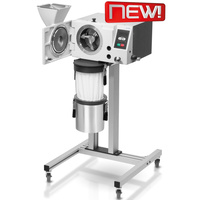
Size reduction and deagglomeration in the SR 300 are achieved by impact and shear effects. The feed material passes from the hopper into the center of the grinding chamber where it is crushed between the rotor, sieve and grinding inserts. As soon as the material is smaller than the aperture size of the sieve it enters the collecting receptacle. The quick-acting door lock ensures easy access to the grinding chamber for quick cleaning. With their motor brake (braking time < 0.5 s), safety switch, splashback and access barrier in the inlet and outlet areas, Rotor Beater Mills offer the highest degree of operating safety.
with rotor, 240 mm filter hose and collecting receptacle (please order retaining frame, sieves and optional base frame SR 200 separately)
|
Mills Appliance type:
|
rotor-/beater mill
|
|
Process type:
|
inlinebatch
|
| Model |
Rotor Beater Mill SR 300 |
| Applications |
size reduction, deagglomeration |
| Field of application |
agriculture, chemistry / plastics, construction materials, environment / recycling, food, geology / metallurgy, medicine / pharmaceuticals |
| Feed material |
soft, medium-hard |
| Material feed size* |
< 15 mm |
| Final fineness* |
< 50 µm |
| Speed at 50 Hz (60 Hz) |
8,100 min-1 (9,700 min-1) |
| Rotor peripheral speed |
58 m/s (69.5 m/s) |
| Types of rotors |
rotor beater / standard / distance |
| Material of grinding tools |
stainless steel: grinding chamber / ring sieves / retaining frame - chromium plated: retaining frame |
| Sieve sizes |
trapezoid holes 0.08 / 0.12 / 0.20 / 0.25 / 0.50 / 0.75 / 1.00 / 1.25 / 1.50 / 2.00 mm
round holes 3.00 / 4.00 / 10.00 mm |
| Collector capacity |
5 l / optional: 30 l |
| Drive |
3-phase motor |
| Electrical supply data |
different voltages |
| Power connection |
3-phase |
| Protection code |
IP 54 |
| Power consumption |
2.2 kW |
| W x H x D closed |
560 x 1200 x 890 mm (with base frame) |
| Net weight |
~ 95 kg |
| Standards |
CE |
*depending on feed material and instrument configuration/settings