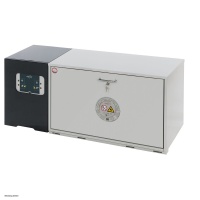
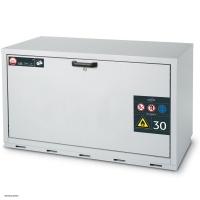
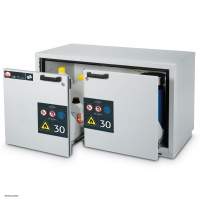
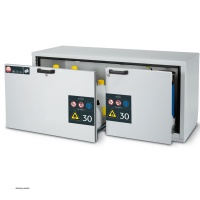
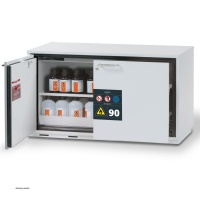
asecos UB-S-30 safety base cabinet, 140 cm
The asecos UB-S-30 safety base cabinet, 140 cm, is an efficient solution for anyone looking for a compact yet extremely reliable way to store hazardous substances in laboratories or research facilities. Thanks to its 30-minute fire resistance and robust construction, this model provides optimum protection for its contents against harmful influences while offering a high level of user comfort. Compared to conventional safety cabinets, it stands out in particular for its space-saving dimensions and flexible interior fittings. High-performance storage for chemicals and more
This under-bench cabinet is specially designed to safely store flammable liquids, solvents, acids and other critical substances in professional environments. Its well-thought-out design is particularly advantageous in laboratory situations where various bottles, containers and accessories need to be stored at the same time. Thanks to its perfectly adapted internal dimensions and solid load capacity of up to 300 kg, even heavy containers can be accommodated with ease. - Fire resistance: 30 minutes (according to DIN EN 14470-1) - External dimensions (W x D x H): 1400 x 550 x 600 mm
- Empty weight: 145 kg for stable, durable construction
- Max. load capacity: 300 kg for heavy laboratory equipment
- Exhaust air connection (NW 75 mm): for safe ventilation and odour control
- Pressure loss in cabinet: < 1 Pa for efficient air exchange
- Certifications: CE marking and DIN EN 14470-1
In addition, the model features a combined interior consisting of a floor drip tray and pull-out trays, supplemented by perforated sheet metal inserts. These elements not only make cleaning easy, but also ensure maximum safety in the event of leaks or spills. The exhaust air connection supports constant air circulation and reduces the risk of vapour concentration. The reinforced door construction in combination with 30 minutes of fire resistance provides further protection in the event of potential fires.
The manufacturing process complies with all current standards for handling hazardous substances. With the recognised CE marking and compliance with the DIN EN 14470-1 standard, the cabinet leaves nothing to be desired in terms of safety and quality requirements in a professional environment.
Specific applications
- Chemical laboratories: For the safe storage of acetone, methanol, ethanol and other sensitive liquids.
- Research facilities: For the storage of solvents such as toluene and xylene, which are often used in synthesis.
- Medical facilities: Suitable for storing various reagents, disinfectants and hazardous substances.
- Universities: Ideal for storing acids and bases such as sulphuric acid or caustic soda, as well as gas cylinders in smaller laboratories.
Its compact size makes the cabinet attractive for confined working environments without compromising on safety. All inserts can be easily removed or adjusted so that different container sizes can be organised.
FAQs
How does the ventilation work?
The integrated exhaust air opening (NW 75 mm) can be connected to an existing exhaust air system. This ensures continuous extraction of any vapours or odours. The pressure loss in the cabinet is less than 1 Pa, which makes the air flow particularly efficient.
Do I have to anchor the cabinet firmly to the floor?
In many laboratories and research facilities, anchoring is mandatory or advisable in order to achieve maximum stability. However, the robust design and an empty weight of 145 kg reduce the risk of tipping over even without anchoring.
Are additional shelves necessary?
The model is delivered without interior fittings. However, it offers compatible pull-out and drip trays as well as perforated plate inserts that can be added as required. In this way, the interior can be adapted precisely to the substances to be stored.
What standards does the cabinet comply with?
The base cabinet complies with DIN EN 14470-1 and is CE certified. This ensures that it meets the essential European safety requirements for flammable liquids.
Can I store different types of hazardous substances at the same time?
In theory, mixed storage is possible, provided that the applicable guidelines and regulations on the compatibility of the substances are observed. Separate storage of acids and bases, for example, may be advisable in order to prevent undesirable chemical reactions.
Conclusion
This safety cabinet offers a well-designed combination of space-saving storage and reliable protection against heat, flames and escaping vapours. The sturdy construction, flexible interior design and easy connection to exhaust air systems guarantee high practical benefits in a wide range of areas. At the same time, the product meets all relevant certifications, meaning that professionals in research, laboratories and medicine can always rely on the highest level of safety and quality.