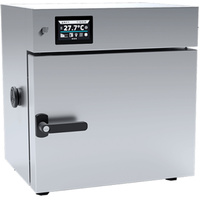
BINDER BD 23 Incubator
The BINDER BD 23 incubator is a sophisticated solution for the precise and reliable incubation of microbiological and medical samples in professional laboratory environments. It is primarily aimed at users in micro and molecular biology, food analysis, medicine, and pharmaceutical research who place the highest demands on temperature stability, safety, and disinfectability. The unit features advanced technologies such as natural convection, the proven APT.line preheating chamber technology and an efficient disinfection routine - features that clearly set it apart from standard incubators.
Precise temperature control and tried-and-tested equipment
The incubator is designed to ensure that processes such as the cultivation of microorganisms, germ tests, long-term experiments and development processes can be carried out safely and reproducibly. Homogeneous and precise temperature control is essential, especially when cultivating temperature-sensitive samples. This is ensured by the intelligent interaction of natural convection, sophisticated air flow and innovative APT.line preheating chamber technology. Users benefit from constant temperature distribution - even without disruptive fan influences. The outstanding features of the BD 23 are:
-
Natural convection: Guarantees gentle, even temperature distribution without mechanical air movement, ideal for sensitive cultures.
-
State-of-the-art APT.line preheating chamber: Ensures precise adherence to setpoints and minimises temperature fluctuations.
-
Disinfection routine at 100 °C: Unrivalled in its reliability, it enables safe decontamination of the interior to effectively prevent cross-contamination.
-
Safety glass inner door (ESG): Additional personal protection and optimal visibility without affecting the temperature level.
-
User-friendly controller with 2 time functions: Allows flexible, practical timer settings for various experimental processes.
-
Class 3.1 temperature monitor (DIN 12880) with alarm: Continuously monitors the temperature and warns of deviations in accordance with the highest safety standards.
Key technical data at a glance:
- Internal volume: 20 litres
- Temperature range: +5 °C above ambient to +100 °C
- Spatial temperature deviation at 37 °C: ±0.5 K
- Temporal temperature deviation at 37 °C: ±0.2 K
- Permissible total load: 25 kg, load per grid 12 kg (2 series, optionally up to 3 grids)
- Dimensions (internal): 222 mm (W) x 330 mm (H) x 277 mm (D)
- Dimensions (external): 435 mm (W) x 495 mm (H) x 520 mm (D), plus 105 mm for handle and exhaust pipe
- Energy consumption at 37 °C: 11 W
- Nominal voltage: 230 V (50/60 Hz) or 115 V (60 Hz)
- IP protection class: IP 20 according to EN 60529
- Weight (empty): approx. 26-27 kg
The sophisticated design and sturdy mechanics ensure maximum service life and reliability in routine and long-term operation. Adaptable insert grids, a compact design and low energy consumption make the BD 23 particularly attractive when it comes to the efficient use of laboratory space and resources.
Certifications and standards
The unit complies with the requirements of DIN 12880 and has a class 3.1 temperature selector guard. The internal temperature profile and the presence of a visual alarm system provide additional reliability - especially when working with valuable or sensitive samples and cultures.
Typical areas of application and uses
The BD 23 has a wide range of applications in scientific, medical and industrial laboratories. Typical uses are:
-
Cultivation of microorganisms (e.g. E. coli, S. cerevisiae, moulds): Optimal conditions for the growth and selection of bacterial and fungal cultures in microbiology and biotechnology.
-
Incubation of eggs and insect larvae: Suitable for developmental biology, zoological experiments and breeding programmes.
-
Long-term and stability studies: Ideal for laboratory studies with specific timetables due to precise temperature control.
-
Creation of bacterial cultures (e.g. Salmonella, Staphylococcus): Standard procedure in clinical laboratories, food control and environmental analysis.
-
Growth of cell cultures: Perfect conditions for animal and plant cell lines under controlled temperature conditions.
FAQs
How often should the disinfection routine be performed?
The frequency depends on laboratory standards. Recommendations for regular use depend on the risk of contamination, for example weekly or before experiments with samples that are particularly sensitive to contamination.
Can the device be used for mammalian cell cultures?
Yes, sensitive mammalian cells can also be cultivated under suitable temperature conditions, whereby the stable environment and the absence of mechanical air circulation are particularly advantageous.
How does the temperature alarm work?
An integrated temperature monitor constantly monitors the interior and triggers a visual alarm as soon as deviations from the preset values are detected.
What are the special features of the safety technology?
ESG safety glass and compliance with DIN 12880 (Class 3.1) ensure maximum safety. The electronic control system protects against overheating and system errors and offers additional user protection.
Conclusion
With its sophisticated technology, high temperature precision, user-friendly safety features and versatile applications, the BD 23 is a top-class incubator for demanding laboratory applications. Above all, its maintenance-friendly disinfection routine and strictly standard-compliant safety features make it the first choice for laboratories that value reliable results, user protection and sterility.

 Details

 Details

 Details
 Details
 Details


 Details
 Details
 Details
 Details

 Details

 Details
 Details