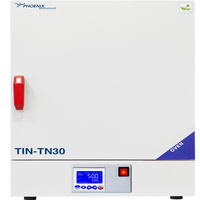
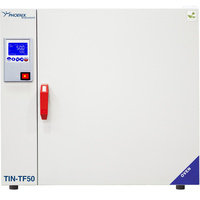
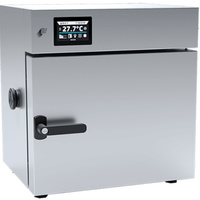
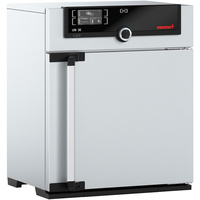
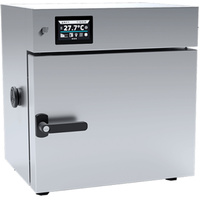
PHOENIX Instrument Heating and Drying Oven TIN-TN Series
from +5 °C above room temperature up to +300 °C
Ideal for daily drying and sterilisation processes, the natural air movement heating and drying ovens offer reliable temperature accuracy and ease of use.
The maximum temperature of up to 300 °C enables all types of sterilisation.
Short heat-up times, uniform heat output and the consistent insulation of the cabinets ensure low energy consumption for every application.
Super series
The new Super series is equipped with a colour touch screen display of the latest generation. Professional control thanks to 8 storable programmes with 8 steps each and a further basic programme (PROG 0). The accumulating data is stored in the unit or via the USB interface. All models except the TIN-TN30 can be ordered as a ''super version''.
At a glance
The various functions can be displayed and selected via the colour touch-screen display. All parameters on a single screen: Temperature, fan speed, running time, programme number and step, presence of USB stick, date and time.
Easy to use
Simple and intuitive setting of all operating parameters thanks to easy-to-understand icons. The capacitive display can be operated precisely even with gloves.
Programmes
Professional control with 8 storable programmes with 8 steps each and another basic programme (PROG 0) with one step. Easy programming of all steps in a single screen.
Safety
Settings menu with 3 levels of access: 1 free and 2 password-protected to prevent accidental changes to ''sensitive'' machine parameters.
Data storage
Work cycles are automatically stored in the machine and are available for download at any time thanks to the USB port. When a USB stick is inserted, registration takes place without capacity limitations.
Basic series
New version of the Basic controller - 7 programmes with 10 steps each and a large backlit LCD display. Easy setting of all operating parameters (except model TIN-TN30).
Phoenix Instrument incubators and drying ovens allow easy setting of all operating parameters and optimal temperature control.
The large, backlit display clearly shows the set temperature and other parameters at all times.
Intuitive, user-friendly symbols and the clearly laid-out keypad enable easy operation of the unit.
Special attention was paid to the insulation of the units and the resulting positive environmental properties. A test certificate is included with all units.
Basic version
- 7 programmes x 10 programme steps
- repeatable working cycles
- large, backlit display
- simple operator guidance
- alarm function
- adjustable fan speed
- programme delay
- safety temperature to protect against overheating
- Time function
|
Load max.:
|
11 - 50 kg51 - 100 kg101 - 150 kg151 - 200 kg
|
|
Width outside (incubators,...):
|
460 mm690 mm815 mm940 mm
|
|
Width inside (incubators,...):
|
320 mm400 mm520 mm650 mm
|
|
Maximum temperature (heat):
|
+ 200 °C+ 300 °C
|
|
Height outside (incubators,...):
|
635 mm685 mm750 mm905 mm
|
|
Height inside (incubators,...):
|
320 mm420 mm495 mm640 mm
|
|
Interior volume:
|
up to 50 l101 - 200 l
|
|
Air convestion (incubators, ...):
|
natural
|
|
Cabinet type:
|
heating oven
|
|
Depth outside (incubators,...):
|
470 mm530 mm600 mm660 mm
|
|
Depth inside (incubators,...):
|
285 mm330 mm450 mm495 mm
|
|
Lowest temperature (cooling):
|
+ 5 °C
|